

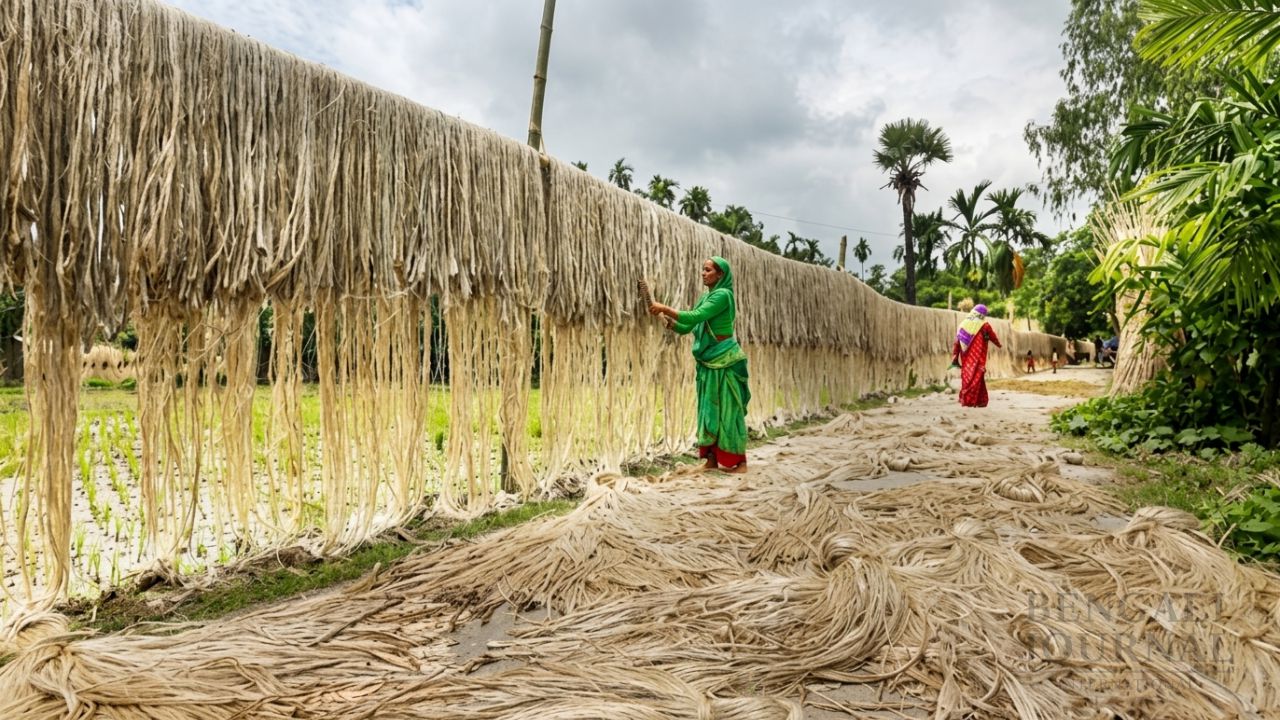
Green fields of jute once stretched across Lalmonirhat, earning the crop its name the "golden fiber." Today that picture is disappearing. Farmers in the district are abandoning jute farming due to rising costs, low market prices, and a severe water shortage.
Official figures from the Department of Agricultural Extension (DAE) show a steep decline in 2022–2023 Farmers grew jute on 3,720 hectares of land. 2023–2024 Cultivation dropped to 2,400 hectares. 2024–2025 Cultivation has collapsed to less than 300 hectares the lowest level in decades.
Farmers say it is no longer profitable to grow jute. Rising prices for seeds, fuel, fertilizers, and farm labor have pushed production costs to about Tk 2,500 per maund (37 kg). However, farmers can only sell their jute for Tk 2,000 to Tk 2,200 per maund. This leaves them with a loss of Tk 300 to Tk 500 on every maund they harvest.
Jute requires water soaking (retting) after harvest to extract the fiber. Due to poor rainfall and dried-up canals, ponds, and streams, farmers cannot find nearby water bodies. Transporting the heavy stalks to distant rivers adds extra labor and cost.
"Last year, I grew jute but couldn't find any water nearby to soak it," said Rafiqul Islam, a 55-year-old local farmer. "I had to carry it far away, and I lost money in the end. This year, I switched to maize and rice instead."
To avoid losses, most farmers in Lalmonirhat are switching to crops like maize, rice, and vegetables, which are easier to manage and offer better profits.
Agriculture officials say they are trying to teach farmers modern "ribbon retting" techniques a method that requires much less water and are planning government support to save the crop. However, experts warn that without quick intervention and fair market prices, jute farming may soon disappear completely from the district.




Friday, July 31, 2026
Publish Date : July 31, 2026
Green fields of jute once stretched across Lalmonirhat, earning the crop its name the "golden fiber." Today that picture is disappearing. Farmers in the district are abandoning jute farming due to rising costs, low market prices, and a severe water shortage.
Official figures from the Department of Agricultural Extension (DAE) show a steep decline in 2022–2023 Farmers grew jute on 3,720 hectares of land. 2023–2024 Cultivation dropped to 2,400 hectares. 2024–2025 Cultivation has collapsed to less than 300 hectares the lowest level in decades.
Farmers say it is no longer profitable to grow jute. Rising prices for seeds, fuel, fertilizers, and farm labor have pushed production costs to about Tk 2,500 per maund (37 kg). However, farmers can only sell their jute for Tk 2,000 to Tk 2,200 per maund. This leaves them with a loss of Tk 300 to Tk 500 on every maund they harvest.
Jute requires water soaking (retting) after harvest to extract the fiber. Due to poor rainfall and dried-up canals, ponds, and streams, farmers cannot find nearby water bodies. Transporting the heavy stalks to distant rivers adds extra labor and cost.
"Last year, I grew jute but couldn't find any water nearby to soak it," said Rafiqul Islam, a 55-year-old local farmer. "I had to carry it far away, and I lost money in the end. This year, I switched to maize and rice instead."
To avoid losses, most farmers in Lalmonirhat are switching to crops like maize, rice, and vegetables, which are easier to manage and offer better profits.
Agriculture officials say they are trying to teach farmers modern "ribbon retting" techniques a method that requires much less water and are planning government support to save the crop. However, experts warn that without quick intervention and fair market prices, jute farming may soon disappear completely from the district.


আপনার মতামত লিখুন